





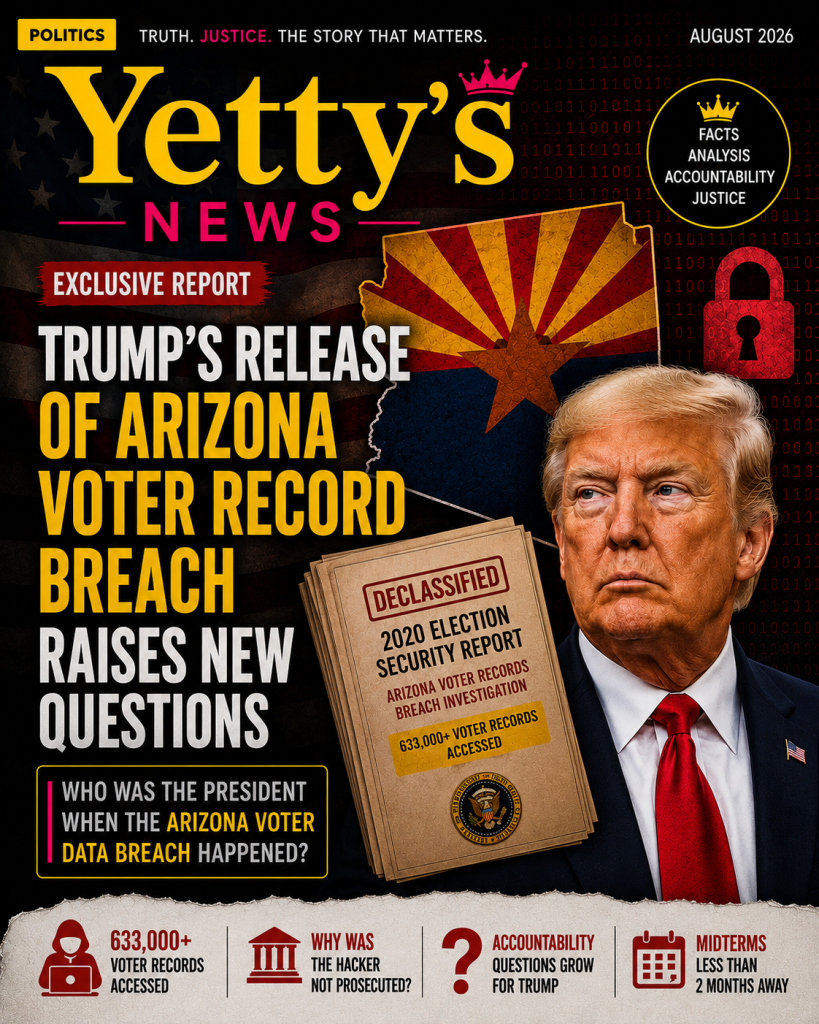
Trump’s Release of Arizona Voter Record Breach Raises New Questions: Who Was President When the Arizona Voter Data Breach Happened?
 YETUNDE
August 10, 2026
💬 0 Comments
YETUNDE
August 10, 2026
💬 0 Comments
A newly released set of declassified FBI documents has reignited debate over election security, cybersecurity and government accountability after detailing a breach involving voter registration records in Maricopa County, Arizona, shortly before the 2020 presidential election.
According to the documents, more than 600,000 voter registration records were accessed during the cyber incident. The case was investigated by federal authorities, who traced the activity to an individual in Arizona who reportedly acknowledged accessing the records.
Despite the unauthorized access, federal and state prosecutors ultimately declined to pursue charges. That decision is now attracting renewed attention as the documents become public years later.
What Did the Hacker Actually Access?
The most important distinction in the case is what the hacker actually accessed. The incident involved voter registration records, not ballots. Investigators found no evidence that votes were changed, ballots were manipulated, voter records were deleted or the outcome of the 2020 election was affected.
The vulnerability that allowed the access was subsequently addressed, and information about the weakness was reportedly shared more broadly so election officials could strengthen protections against similar incidents.
Still, the absence of a prosecution has become one of the biggest questions surrounding the newly released material. Unauthorized access to computer systems can be a criminal offense, leaving some observers questioning why an individual who reportedly admitted accessing the records was not charged.
A decision not to prosecute, however, does not necessarily mean authorities considered the conduct acceptable. Prosecutors may decline cases for numerous reasons, including questions about available evidence, criminal intent, jurisdiction or whether they believe they can prove the required elements of an offense in court.
Who Was President When the Incident Happened?
The documents have also renewed discussion about who occupied the White House when the incident occurred.
Donald Trump served as president from January 20, 2017, until January 20, 2021. The Arizona incident therefore occurred during his first presidential administration.
That timeline has become part of the political discussion surrounding the release. Critics argue that if the incident is presented as evidence of a serious government failure to protect election infrastructure, questions must also be asked about how federal agencies operating during Trump’s administration responded to that failure.
Others argue that the disclosure demonstrates why election systems require stronger cybersecurity protections regardless of which political party controls the White House.
The distinction is important because evidence that someone accessed voter registration information is not, by itself, evidence that an election was stolen or manipulated.
Why Election Cybersecurity Matters
Voter databases and election infrastructure remain attractive targets for hackers, foreign governments and other malicious actors. Protecting those systems is therefore an important national security responsibility, even when an intrusion does not affect actual votes.
The timing of the disclosure has also generated political debate as the United States moves toward another election season. Some observers believe renewed attention on vulnerabilities from 2020 could strengthen arguments for greater election security.
Others worry that information about cybersecurity incidents can be misunderstood or presented without sufficient context, potentially causing people to believe ballots were compromised when investigators found no such evidence.
Trump’s Broader Record Enters the Discussion
Trump’s broader record has also entered the conversation, including debate surrounding his use of presidential pardons. Those matters are separate from the Arizona hacking incident, and there is no evidence that the individuals who received those pardons were connected to this particular breach.
The Arizona case should therefore be evaluated on its own evidence.
The central facts described in the documents remain straightforward: voter registration information was accessed without authorization, the records were not altered or deleted, ballots were not involved, investigators found no evidence that votes were changed, the vulnerability was addressed, and prosecutors did not bring charges.
The incident also occurred while Donald Trump was the sitting president of the United States.
Questions That Remain
Those facts leave legitimate questions for government officials. Why was prosecution declined? How serious was the vulnerability? What protections were implemented afterward? And what lessons were learned that could prevent another intrusion?
As political arguments surrounding the disclosure continue, separating cybersecurity concerns from unsupported claims of election fraud will be essential.
A breach of voter information deserves scrutiny. So does the government’s response to it.
But the evidence must determine the conclusions.
Yetunde B. Reports for Yetty’s News

YETUNDE
Writer at Yetty's Records, covering music, lifestyle and entertainment.