





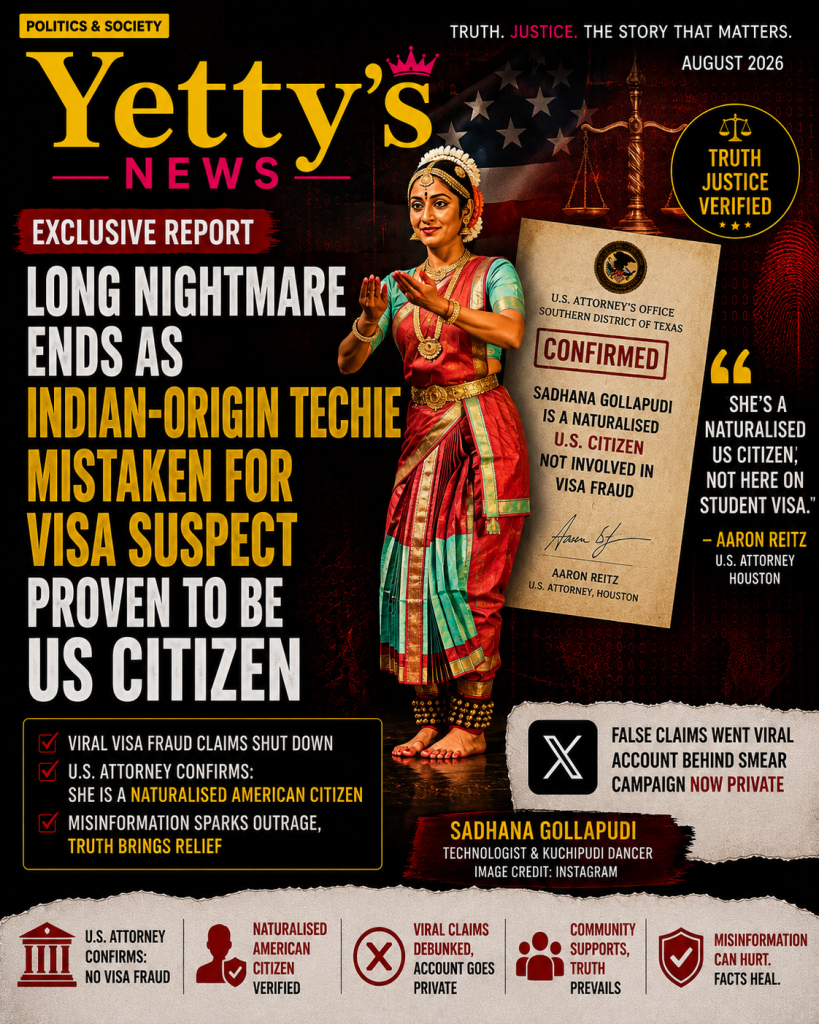
Long Nightmare Ends as Indian-Origin Techie Mistaken for Visa Suspect Proven to Be US Citizen
 YETUNDE
August 10, 2026
💬 0 Comments
YETUNDE
August 10, 2026
💬 0 Comments
For days, Houston-based technologist and Kuchipudi dancer Sadhana Gollapudi found herself at the center of a social media firestorm after being falsely accused of visa fraud. What began as an online allegation quickly spread across social media, drawing widespread attention before authorities stepped in to clarify a crucial fact: Gollapudi is a naturalized United States citizen, not an international student living in the country on an F-1 visa.
How the Controversy Began
The controversy reportedly began when an X account called Cyber Green 09 alleged that Gollapudi had been living in the United States on a student visa and had violated immigration rules by working while pursuing academic programs. Videos of Gollapudi performing classical Indian dance were also circulated as supposed evidence supporting the allegations.
The claims spread rapidly, with social media users reposting and discussing Gollapudi’s immigration status before the information had been properly verified. What may have started as posts from a single account soon developed into a much larger online controversy involving a real person’s name, photographs, professional background, and reputation.
US Attorney Clarifies Gollapudi’s Citizenship Status
The situation eventually attracted the attention of Aaron Reitz, US Attorney for the Southern District of Texas, who publicly addressed the allegations.
Reitz stated that Gollapudi is a naturalized US citizen and is not in the United States on a student visa. His clarification directly undermined the central allegation being circulated about her immigration status.
The confirmation dramatically changed the story. The accusations had largely depended on the assertion that Gollapudi was an F-1 student who was allegedly violating restrictions associated with that immigration status. Once authorities confirmed that she is an American citizen, the foundation of that accusation collapsed.
Concerns Over Misinformation on Social Media
The controversy has since raised broader concerns about how quickly unverified claims can spread on social media and how much damage can occur before the truth catches up.
The Indian American Advocacy Council condemned the situation, expressing concern that an American woman had been publicly identified and accused of visa fraud before her actual status had been established.
Gollapudi also responded to the ordeal, describing the experience as “incredibly difficult and upsetting.” She said her content had been reposted without permission and used alongside allegations that were false. She encouraged social media users to report posts containing misinformation and unauthorized use of her content.
The Dangers of Viral Accusations
The case demonstrates the extraordinary speed at which an accusation can become an online narrative. A person’s photographs, videos, employment history, education, and immigration status can suddenly become the subject of speculation by thousands of strangers, sometimes before anyone stops to determine whether the original allegation is even true.
Visa fraud is a serious matter, and authorities have a responsibility to investigate credible allegations. But publicly accusing an identifiable person of committing a crime is also serious. Verification matters, particularly when an accusation has the potential to damage someone’s reputation, career, and personal life.
A Public Correction
With Gollapudi’s citizenship status now publicly clarified, the central visa allegation that fueled the controversy has fallen apart.
For Gollapudi, what began as several difficult days of accusations and unwanted attention has ended with an important public correction. The episode also leaves behind a warning for the social media era: a viral accusation can travel around the world in hours, but popularity does not turn an allegation into a fact.
Yetunde B. Reports for Yetty’s News

YETUNDE
Writer at Yetty's Records, covering music, lifestyle and entertainment.