




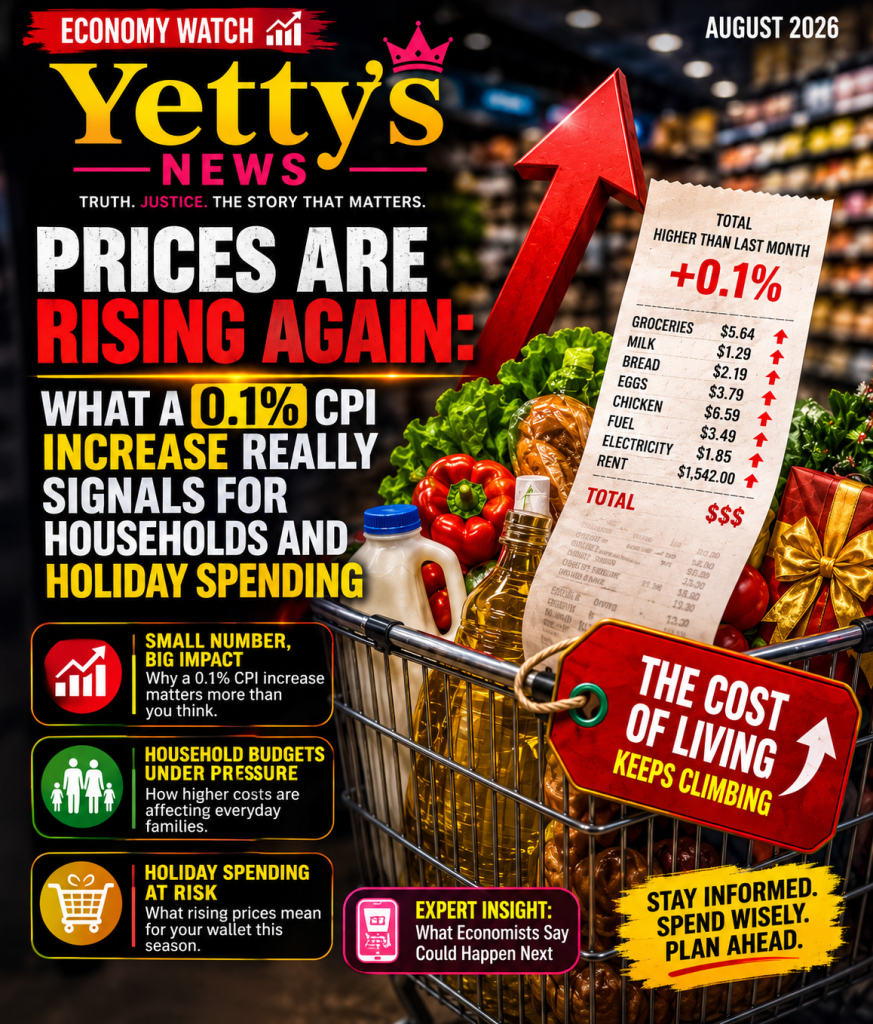
Prices Are Rising Again: What a 0.1% CPI Increase Really Signals for Households and Holiday Spending
 YETUNDE
August 19, 2026
💬 0 Comments
YETUNDE
August 19, 2026
💬 0 Comments
By Yetunde B. | Yettys News
A 0.1% increase may not sound like much. But when it shows up in the cost of groceries, rent, transportation and other everyday expenses, American households can feel the difference.
The latest U.S. Consumer Price Index (CPI) figures show consumer prices rising 0.1% in July, while annual inflation remains at 3.4%. The numbers suggest that although the rapid inflation of previous years may have eased, the pressure on household budgets has not disappeared.
For consumers, that distinction matters.
Inflation does not have to surge dramatically for families to feel squeezed. When prices continue rising month after month, even at a slower pace, households must spend more simply to maintain the same standard of living.
Inflation Is Only Part of the Story
The bigger concern is that persistent prices are arriving alongside signs of a slowing economy.
The U.S. economy reportedly lost 23,000 jobs in July, while private employers added only 44,000 workers, falling short of expectations.
Weak hiring can be an early indication that businesses are becoming more cautious. Companies may delay expansion, reduce recruitment or leave positions unfilled when they are uncertain about future demand.
Economic growth is also showing signs of cooling. Second-quarter growth slowed to 1.5%, while core inflation remained around 3.3%.
Taken together, these numbers present a difficult combination: economic activity is slowing, but prices remain elevated.
The Pressure Is Global
The United States is not facing these challenges in isolation.
Parts of Europe are dealing with severe drought conditions that threaten agriculture, transportation and economic activity. China has faced weaker factory activity amid softer demand and weather disruptions, while India’s inflation accelerated to 4.38% in June.
These developments matter to American consumers because today’s economy is deeply interconnected. Problems affecting manufacturing, agriculture, shipping or energy overseas can eventually influence prices in U.S. stores.
What Does This Mean for Households?
Groceries and Rent May Remain Painful
A slower inflation rate does not mean prices are returning to where they were several years ago. It simply means prices may be increasing more slowly.
For households already paying significantly more for food, housing, insurance and transportation, even modest additional increases can hurt.
Holiday Spending Could Become More Cautious
The holiday shopping season is approaching, and households may begin making difficult choices.
Families worried about inflation or employment could reduce spending on travel, gifts, restaurants, entertainment and other nonessential purchases.
Instead of asking, “What do we want to buy?” more households may be asking, “What can we afford to buy?”
That shift matters to retailers and the broader economy because consumer spending remains one of America’s most important economic engines.
Borrowing Could Remain Expensive
Persistent inflation also complicates the outlook for interest rates.
Credit-card balances, car loans and mortgages have already become expensive for many borrowers. If inflation remains stubborn, policymakers may have less room to lower interest rates aggressively.
For consumers carrying debt, that can mean another period of high monthly payments and expensive borrowing.
Paychecks May Not Feel Like They Go as Far
Even when wages increase, households can still feel financially worse off if the prices of necessities rise faster than their income.
A family may technically earn more money than it did a few years ago while still feeling poorer at the supermarket, at the gas station or when the rent is due.
That is one reason inflation remains such an important kitchen-table issue.
A Cooling Economy — Not Necessarily a Collapsing One
The current numbers do not automatically point to an economic collapse.
But they do suggest an economy caught in an uncomfortable position: prices remain high, hiring appears weaker and economic growth is slowing.
For Wall Street, these may simply be numbers on a screen.
For ordinary households, they translate into something much more personal: deciding whether to travel for the holidays, how much to spend on Christmas gifts, whether to carry another credit-card balance, or whether a family can afford the same grocery basket it bought last year.
A 0.1% increase may look tiny on paper.
At the kitchen table, however, every increase counts.
Yetunde B. reports for Yettys News.

YETUNDE
Writer at Yetty's Records, covering music, lifestyle and entertainment.